“One must be careful of books, and what is inside them, for words have the power to change us.” —Cassandra Clare, The Infernal Devices
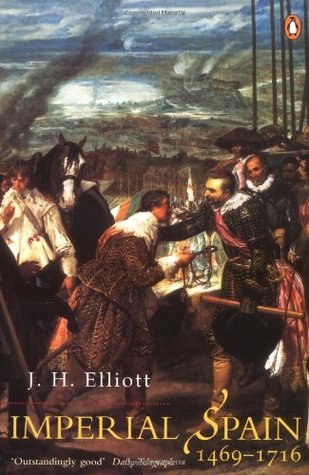
"For the better or for the worse." -- John DalyOn Wednesday, the 9th of December, nine members of the club met to discuss Imperial Spain: 1469-1716 by J. H. Elliott. (A couple more contacted me after the meeting reporting problems that prevented their attendance.) Fittingly for the December meeting, the Kensington Row Bookshop was decorated for the season and cookies were served.
A Theory of History
About 10,000 years ago, agriculture began to be practiced by our species. By increasing the amount of food supplied and its dependability, agriculture allowed population size to grow. But the spread of agriculture across continents could not have been rapid. For millenia hunger was a regular part of human existence; in Hobbs phrase, it was "solitary, poor, nasty, brutish, and short".

Wikipedia estimates:
The world population in 35,000 BCE is estimated to have been around 3 million people, all of whom subsisted as hunter-gatherers. The population had increased to around 15 million at the time agriculture emerged in around 10,000 BCE. By contrast, it is estimated that around 50–60 million people lived in the combined eastern and western Roman Empire in the 4th century CEToday people live in nation-states that control virtually all the the land on earth, and have created multinational organizations such as the United Nations, the World Health Organization, and the World Trade Organization that have global programs doing what the nation states can not themselves do. World population reached 7 billion in about October 2011. The United Nations estimates it will increase to 11.2 billion in the year 2100. More is produced and consumed than ever before. Men have walked on the moon, robotic vehicles have explored some of the plants, and space vehicles have mapped them all,
This has not been achieved by a plan, but rather by muddling through, with many small plans for limited objectives, and even many of these have failed or been only partially successful, For ever two steps forward, one has had to be given up to retreat. Spain from 1469 to 1716 deals with an important culture at an important time. This was a time in which new wealth was entering world commerce, many European nations were modernizing their governments (while Spain lagged) and the modern age had almost arrived in Europe.
The early part of this period saw the Catholic Monarchs succeed in ending Muslim presence in the Iberian peninsula. Then Spain and Portugal gained huge. rich colonies in the Americas, established trading routes from Europe to Asia and established more colonies and trading entrepôts in Asia. At the end of the period, the Hispanic peoples took a huge step back from those successes as the empire collapsed. Elliott seems to suggest that a lot of this history was the result of kings and their subordinates muddling through.
Elliott shows how the huge amounts of gold and silver were raised to fund government activities over this long period. He also goes into detail on how government action emerged from conflict among social classes and among geographic regions -- it was anything by the well organized execution of a rational master plan. Kings and aristocratic leaders were doing the best they could with institutions that were often inadequate raising needed finance or directing the far flung agents of government. Thus seen in one way, Elliott's book is a confirmation that muddling through during this period and in this region worked well, but then stopped doing so. But while Spain was suffering its reverses, other nations were making progress. The book thus involves a serious theory of how government reacts to unforeseen fortuitous and disastrous event, or at least how Spanish governments reacted in the 15th to the 18th century..
Background
Sir John Elliott is a very distinguished historian, well known for his works on Spanish history. This book was originally selected because members felt we should know more about Spanish history, especially during the period in which Spain colonized much of the Americas -- after all, much of the United States was first colonized by Spain -- we are an American club even as we deal broadly with world history,. Beginning the book in 1469 allows the author to begin with the ascendancies of Isabella and Ferdinand, well before the 1492 sailing of Columbus; the final date indicates that the War of the Spanish Succession was over, and Phillip the V had extended Castilian rule over Catalonia and the Basque country.
Here is the Amazon summary of the book:
Since its first publication, J. H. Elliott's classic chronicle has become established as the most comprehensive, balanced, and accessible account of the dramatic rise and fall of imperial Spain. Now with a new preface by the author, this brilliant study unveils how a barren, impoverished, and isolated country became the greatest power on earth—and just as quickly fell into decline.
At its greatest Spain was a master of Europe: its government was respected, its armies were feared, and its conquistadores carved out a vast empire. Yet this splendid power was rapidly to lose its impetus and creative dynamism. How did this happen in such a short space of time? Taking in rebellions, religious conflict and financial disaster, Elliott's masterly social and economic analysis studies the various factors that precipitated the end of an empire.Some videos that are helpful in understanding the book:
- Here is a brief review of the book.
- Here is a video of an interview of Sir John Elliott on his life as a historian.
- Sir John H. Elliott at IDB (Why the Spanish and English Experience in Colonization of the Americas were so different).
As you read the review, you might find it useful to have some Spanish music to listen too. Here is a guitar playing Granada from Albeniz' "Suite Española".
The Iberian peninsula of course had a history before 1469. The various tribes inhabiting the peninsula had been conquered by the Romans, who occupied the territory for centuries. However, as the Roman Empire fell, tribes from the north swept into the area taking political and economic control -- notable the Vandals and the Visigoths.
Muslim armies swept up the peninsula to the border of France. I quote from Wikipedia:
The Reconquista had restored Christian domination of the peninsula with the exception of Granada in Andalusia by 1469, leaving only a small portion of the deep south under Muslim rule
Below is a map of the peninsula showing the Catholic crowns of Castile and Aragon as well as the Islamic territory of Granada, with the dates that the territories were incorporated into the Spanish empire. According to Wikipedia:

As the book starts, the last stage of the Reconquista is being prepared.
It is important to realize not only that the political organization of the Iberian peninsula was different in the 15th century than it is today, but that the concepts of states too were different. Thus the Crown of Aragon at the end of the 15th century was composed of the Kingdom of Aragon, the Principality of Catalonia, the Kingdom of Valencia in the Iberian Peninsula, and the Kingdom of Majorca (the Balearic Islands), but it also included the Kingdom of Sicily, the Kingdom of Sardinia. (Thus five kingdoms and one principality were united under the Crown, recognizing a single ruler -- the King of Aragon.) Each of the major subordinate units within a Crown had its own form of government and its own local governors. A new King of Aragon (like a new rulers of Castile or Portugal) occupied the top post, generally without too great a disruption of the governments of the subordinate kingdoms and principalities. Note that Isabella and Ferdinand had a special agreement that each was the co-ruller of others Crown, during their lives,
A context for the first part of the book -- that dealing with the Catholic monarchs of Castile and Aragon (Isabella and Ferdinand) is the completion of the reconquest of the Iberian Peninsula from the Muslims. It also saw the expulsion of the Jews and Muslims.
Of course, the region had been part of the Roman Empire, and then occupied Vandals and Visigoths. The Muslims after sweeping through North Africa, invaded Europe via the Iberian Peninsula and were not stopped until the reached the Pyrenees and the French The Christians on the Peninsula began to take back the land, supported by the rest of Europe, with the notable support of the papacy, By 1468 only Granada was in Muslim hands, the rest of the peninsula was Christian.
While there were many trained and experienced warriors among the Christians, how were they to be paid? The union of Castile and Aragon was a start, since a large area of the region was now under under the Queen of Castile and the King of Aragon, each of whom made the other co-monarch of her/his own domain.
The book focuses on an important economic development -- the development of the woolen cloth industry. A large wool market existed in the north of Castile. The Catholic Monarchs arranged that wool from that market would be transported to a port on the north coast of the Iberian peninsula, from there to be taken by convoy to France where it would be processed into cloth. Not incidentally, this made taxes on the wool easier to collect and a large source of income. A further step was to fence a large area of (relatively poor soils) in the highlands of Castile and reserve them for sheep. Thus the book presents us with an example of commercialization of agriculture to serve the state's need for money.
Part II of the Book
A Habsburg Dynesty ruled Castile during the period covered by the larger part of the book. When Isabella died in 1505, her grandson, Charles V, was the clear inheritor of the position of King of Castile, but was to wait 18 years his majority to assume his duties, The Union of Crowns was preserved during these years, and Charles V was therefor also to be the King of Spain ruling over possessions of Spain in the Americas, Sicily and southern Italy. He was a Habsburg as a result of the complex mating rituals practiced by the royals. His descendants ruled for about a century.
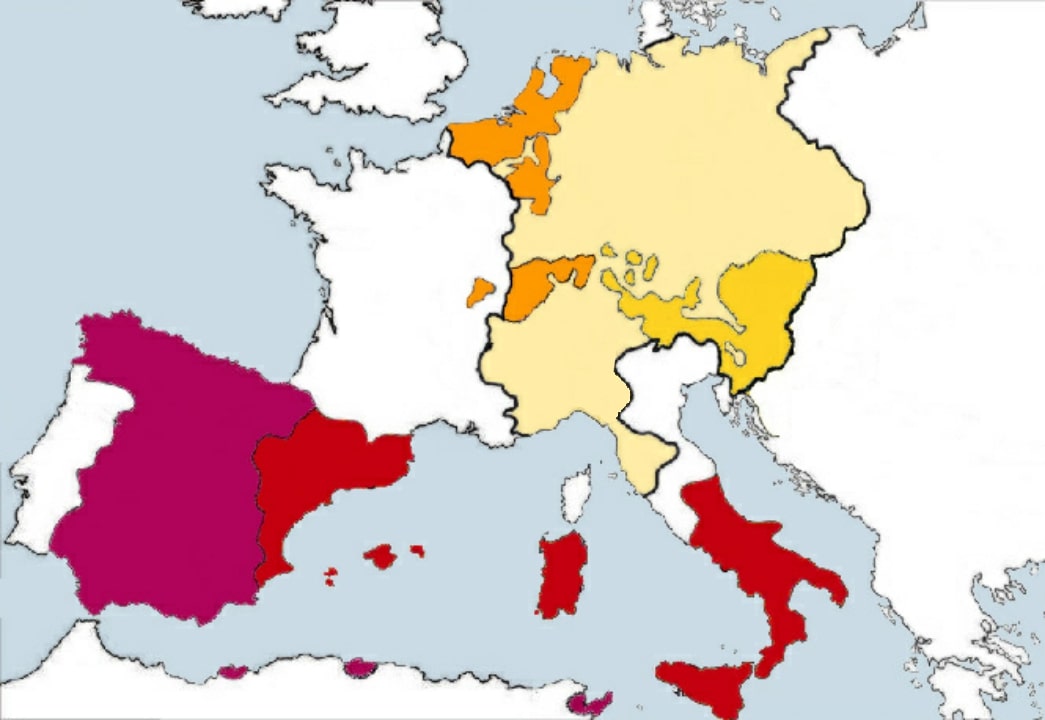
He was also elected Holy Roman Emperer, which brought him large territories in Europe as seen in the map.
Map of the empire of Roman Emperor Charles V (as king of Spain Charles I). Castille Aragon Burgundian possessions Austrian hereditary lands Holy Roman Empire
The obvious implication of the map is that it placed a lot of ground under the control of Charles V (if he and his descendants could hold it). Charles and his advisers were faced by a protestant revolt against the Catholic control of the Netherlands, It devoured money, as Charles had to send troops via Flanders after traveling across a lot of Europe. The royal cashbox was always bare, and from time to time Charles V would have to borrow large sums of money -- exacerbating the problem since he did not reduce expenditures on the Roman Empire, but would need to pay more and more interest.
The 16th century began well for Charles V in terms of the Spanish possession in the America. Since Columbus had landed in the Caribbean, the first explorations started there, and continued in Florida, However, more propitious discoveries were made in Mexico and the Andes, where large populations of relatively highly organized Indians were found, and even more to the Spanish liking, large deposits of Silver.
DECADE Value (million pesos) GOLD (tonnes) SILVER (t)
Early on there was a windfall of money and it goods that could have been produced in Spain were imported at lower prices. It was noted that the innovators -- people engaged in commerce who would detect problems or unmet needs -- were disappearing. The King and the leading aristocrats didn't seem to recognize these as the grave problems that they would become, or at least didn't propose solutions that worked. Muddling through would not be enough;
The anger of the peripheral states at the Spanish King and at Castile increased. I quote from Wikipedia:
A critical moment in the conflict between Islam and Christianity was 1453, when Constantinople fell to the Ottoman Empire. (The History Book Club read 1453: The Holy War for Constantinople and the Clash of Islam and the West by Roger Crowley.) This effectively blocked Christian Europe from access to Asian goods which they had been obtaining via the Silk Road. (The club also read The Silk Road in World History by Xinru Liu.) This in turn led to efforts to find a new route to Asia, notably by ship around Africa. The Iberian peninsula had an advantage in this effort due to its geographical location and direct access to the Atlantic. Thus in 1492, when Grenada fell, it was not strange that Castile and Aragon chartered Columbus' voyage to seek a direct Western route to Asia, assuming that the earth was indeed spherical. What was unexpected was that Columbus discovered the Americas and not Asia, (Muddling though!)
The conquest of Constantinople also opened a route into Europe for the Ottoman armies through the Balkans, and thus a serious threat of Islamic intrusion into the eastern lands of Christian Europe. (The club had also read The Enemy at the Gate: Habsburgs, Ottomans, and the Battle for Europe by Andrew Wheatcroft.) With this new threat, European Christians sought to reorganize to be able to bring forces to oppose invading Islamic forces; money would be a problem. The Holly Roman Empire, by its size and wealth would be an obvious leader.

In 1492 the Kingdom of Castile and Leon was the largest Christian kingdom, with Aragon and Portugal somewhat smaller, the Muslim Kingdom of Granada on the coast in the south, the Kingdom of Portugal on the west, and a small Kingdom of Navarre on the east, But the history of these kingdoms remained alive, Thus the Kingdom of Aragon (in addition to its lands outside of the peninsula) included Aragon, Catalonia and Barcelona. Barcelona had a history as a trading state, dominating sea trade in the north western Mediterranean -- a powerhouse of commerce. Aragon's history included a key role in the defense of the frontier. Catalonia had its own language (with many French roots) and cousins over the border living on French territory. Muddling through never succeeded in bringing Aragon and Castile needed to make Spain a single state serving a single nation, That was more true of the failed experiment with unification of Portugal and Spain, The muddling through approach to unification of Spanish and Moors. the Catholics, Protestants and Jews failed even more dramatically,
In the 17th century there was again a change of dynasty -- from Habsburg to Bourbon, from Austrian to French. It was decided on after the War of the Spanish Succession, A french Bourbon ruler was duly installed in Madrid, and many of the innovations introduced in French government structure and function came to Spain. The Austrians stripped Spain of the territory it had held in Italy and the surrounding Mediterranean Islands.
It would be a shame not to mention the magisterial final section that author Elliott provides to the book, titled "Epitaph to an Empire". In the previous chapters he has delved in great detail to who held what position of what issue related to what decision. It was this detail (involving people the non-historian reader would often soon forget) that so annoyed out member (cited above). In the final section of the book Elliot points out how great were the accomplishments of Spain under Isabella and Ferdinand as well as under the early Habsburgs. The world still has the imprint of those accomplishments. Looking at governments and the people who run them today, one wonders if we have really made advances in 400 years.
Apologies for the late posting of this discussion of Elliott's book on Imperial Spain. The holidays, and a lasting problem with allergies were responsible, John Daly
The Iberian peninsula of course had a history before 1469. The various tribes inhabiting the peninsula had been conquered by the Romans, who occupied the territory for centuries. However, as the Roman Empire fell, tribes from the north swept into the area taking political and economic control -- notable the Vandals and the Visigoths.
Muslim armies swept up the peninsula to the border of France. I quote from Wikipedia:
The Umayyad conquest of Hispania was the initial expansion of the Umayyad Caliphate over Hispania, largely extending from 711 to 788. The conquest resulted in the destruction of the Visigothic Kingdom and the establishment of the independent Emirate of Cordova under Abd ar-Rahman I, who completed the unification of Muslim-ruled Iberia, or al-Andalus (756–788). The conquest marks the westernmost expansion of both the Umayyad Caliphate and Muslim rule into Europe.
Forces commanded by Tariq ibn Ziyad disembarked in early 711 at Gibraltar at the head of an army consisting of Berber Northwest Africans and Arabs. He campaigned his way northward after the decisive Battle of Guadalete against the usurper Roderic. By 717, the Berber-Arabs had crossed the Pyrenees onto Septimania and Provence (734).
Al-Andalus under the Umayyads
 |
| Source: Fred the Oyster - via Wikipedia |
Below is a map of the peninsula showing the Catholic crowns of Castile and Aragon as well as the Islamic territory of Granada, with the dates that the territories were incorporated into the Spanish empire. According to Wikipedia:
The Iberian Union was the period between 1580 and 1640 during which the Crown of Portugal was in dynastic union with the Spanish Crown, bringing the entire Iberian Peninsula, as well as Spanish and Portuguese overseas possessions, under the Spanish Habsburg kings Philip II, Philip III and Philip IV of Spain.
The Iberian Peninsula Showing the Dates Territories were Reconquered by Spain

It is important to realize not only that the political organization of the Iberian peninsula was different in the 15th century than it is today, but that the concepts of states too were different. Thus the Crown of Aragon at the end of the 15th century was composed of the Kingdom of Aragon, the Principality of Catalonia, the Kingdom of Valencia in the Iberian Peninsula, and the Kingdom of Majorca (the Balearic Islands), but it also included the Kingdom of Sicily, the Kingdom of Sardinia. (Thus five kingdoms and one principality were united under the Crown, recognizing a single ruler -- the King of Aragon.) Each of the major subordinate units within a Crown had its own form of government and its own local governors. A new King of Aragon (like a new rulers of Castile or Portugal) occupied the top post, generally without too great a disruption of the governments of the subordinate kingdoms and principalities. Note that Isabella and Ferdinand had a special agreement that each was the co-ruller of others Crown, during their lives,
"The 15th century saw a series of wars between the Kings of Aragon and the Counts of Provence. In 1423 the army of Alphonse of Aragon captured Marseille, and in 1443 the forces of Aragon captured Naples, and forced its ruler, King René I of Naples, to flee. He eventually settled in one of his remaining territories, Provence.......Louis XI of France (was crowned in 1481 and Provence was legally incorporated into the French royal domain in 1486." (Source)The 15th and 16th centuries in Europe obviously fell between the middle ages and the onset of modern times. They were a time in which some key areas of technology changed, as did the processes of religion, government, war, agriculture, manufacturing, and much else.The global context of the history of Spain in the 15th and 16th century includes:
- The conflict between Islamic peoples and Christian peoples, which saw the fall of Constantinople to the Ottoman Empire in 1453, was partially resolved in the west in 1492 by the completion of the Reconquista of the Iberian peninsula by Christians. The emphasis of the conflict toward Austria after 1453 when the Ottomans sought to move north through the Balkans. (In 2012 the club read The Enemy at the Gate: Habsburgs, Ottomans, and the Battle for Europe by Andrew Wheatcroft.)
- During the entire period after the Middle Ages, European rulers were seeking to extend the areas that they ruled, and to do so had to better finance their governments. The 17th century European states (except Spain) succeeded in modernizing governmental institutions.
- There were many armed conflicts among European states achieved some success. Notably, for much of the period discussed in this book, Spanish lands were at war in France, the Netherlands, Italy and/or England,
- The Reformation and Counter-Reformation. These can be considered to have begun with the posting of Luthor's Ninety-Five Theses. Of course the period say the rise of protestant churches which came to enroll states in northern Europe, This of course weakened the Roman Catholic Church, which in response created the Counter-Reformation, (The club had previously read and discussed The Reformation: A History by Diarmaid MacCulloch.).
- The Renaissance (from the 14th to the 17th century), which started in Italy and spread across Christian Europe. Humanism is associated with the Renaissance, but perhaps played a distinct role in some of the theme of Elliott's book. Other aspects of the Renaissance certainly did.
- In 1453, with the fall of Constantinople, the Silk Road allowing trade between Asia and Europe was closed. That led to exploration around Africa seeking a new trade route, and settlements by Europeans along the coast of Africa. The Portuguese and Spanish were well placed to lead this exploration due to their location on the south-western point of Europe.
- 1455 also saw the first books printed using movable type -- the Gutenberg Bible. Printed books became more common after 1455 while hand copied books continued to be produced. Still religious, scientific and other learned tracts became much more available as time went by,
- "The 15th through 17th century saw widespread development in gunpowder technology throughout the Old World. During the 15th and 16th centuries, these developments were more advanced in India and Persia than in Europe, but by the 17th century, technological progress in Europe led to application of gunpowder on a scale and to an effect unprecedented anywhere else, both in warfare and in civil engineering. " Wikipedia
- The fortuitous discovery of America by Columbus (1492) also led to the rapid conquest of large areas of North, Central and South America by Spain and Portugal, the Colombian Exchange of plants, animals and diseases, and relatively quickly to a huge transfer of gold and silver from New World mines to Spain.
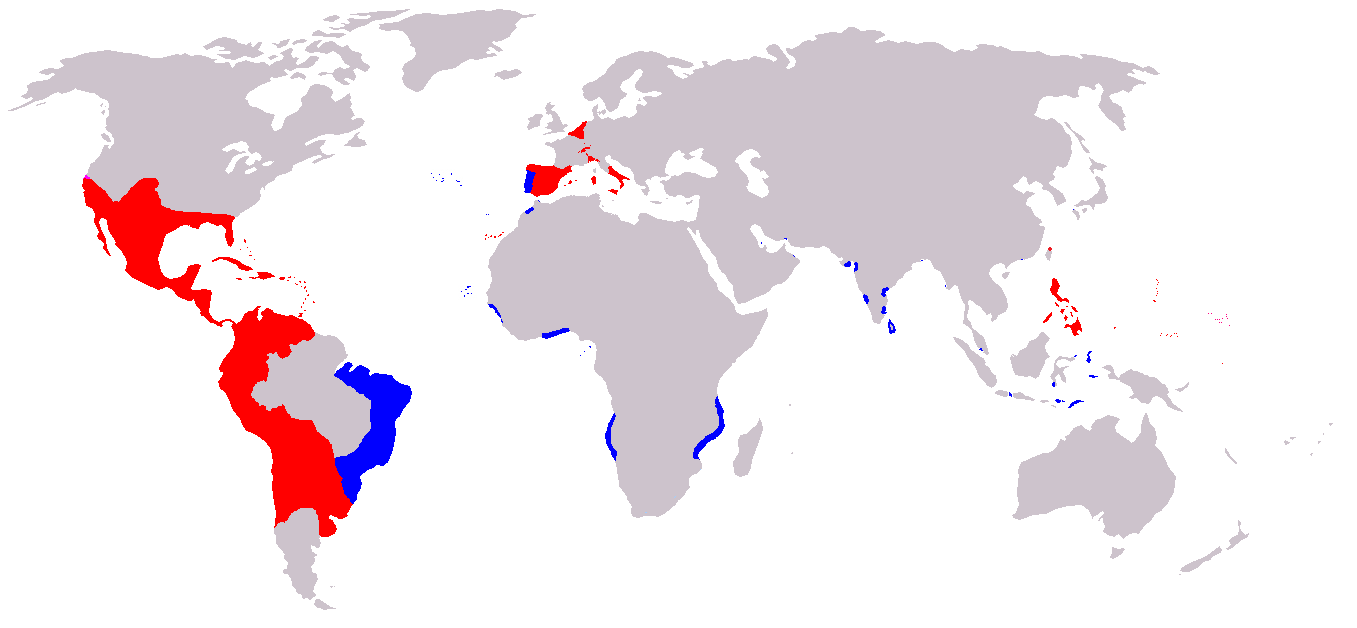 |
| A map of the Spanish and Portuguese Empires in the period of Iberian Union under the personal union of the Spanish monarchs (1580–1640) |
Part I of the Book
A context for the first part of the book -- that dealing with the Catholic monarchs of Castile and Aragon (Isabella and Ferdinand) is the completion of the reconquest of the Iberian Peninsula from the Muslims. It also saw the expulsion of the Jews and Muslims.
Of course, the region had been part of the Roman Empire, and then occupied Vandals and Visigoths. The Muslims after sweeping through North Africa, invaded Europe via the Iberian Peninsula and were not stopped until the reached the Pyrenees and the French The Christians on the Peninsula began to take back the land, supported by the rest of Europe, with the notable support of the papacy, By 1468 only Granada was in Muslim hands, the rest of the peninsula was Christian.
While there were many trained and experienced warriors among the Christians, how were they to be paid? The union of Castile and Aragon was a start, since a large area of the region was now under under the Queen of Castile and the King of Aragon, each of whom made the other co-monarch of her/his own domain.
The book focuses on an important economic development -- the development of the woolen cloth industry. A large wool market existed in the north of Castile. The Catholic Monarchs arranged that wool from that market would be transported to a port on the north coast of the Iberian peninsula, from there to be taken by convoy to France where it would be processed into cloth. Not incidentally, this made taxes on the wool easier to collect and a large source of income. A further step was to fence a large area of (relatively poor soils) in the highlands of Castile and reserve them for sheep. Thus the book presents us with an example of commercialization of agriculture to serve the state's need for money.
A member complained during our meeting that while the book was full of descriptions of people and events, she felt is lacked clear organizing principles. (Perhaps, in defense of author Elliott, he might have assumed the readers would have a broad understanding of the historical situation and processes of the time which would have served that need,)I suggest that "muddling through" is that organizing principle.
Isabella and Ferdinand worked first to undo damaging changes that had been made to earlier practices in the years before their elevation to office. They also succeeded in bringing Castile and Aragon closer together, especially by each recognizing the other as co-monarch over her/his inherited domain. Their work was complicated in that they did not have the modern understanding of administration that has developed over the centuries since they lived. Especially, they did not have the experience of developing professional civil service that we now enjoy.
They were successful in putting together the money to fund a large army, and with that army to defeat Granada and capture the remaining parts of Andalusia from the Muslims. Their expulsion of the Jews led to the loss of that population with its wealth and business experience a serious blow to Castile and Aragon, and indeed the entire Iberian peninsula.
They had good luck, especially in that Columbus discovered America, and America proved to be rich in gold and silver as well as domestic plants. it quickly proved to be a captive and lucrative market for European exports, all of which were shipped on Spanish vessels; hundreds of years of experience fighting Muslims had prepared the Spanish to accomplish exception conquests with tiny forces. None of this could have been imagined when Isabella and Ferdinand agreed to finance the expedition,
Part I of the book emphasizes the many factions involved in policy making with regard to raising funds, organizing the government, conducting military affairs, and conducting relations with the Muslim opposition, The royals themselves, the aristocrats (who were by no means united, and indeed could have various factions for a single issue). the church, the leading townsmen, the lower class townsmen and the peasant farmers. The Inquisition existed, and the church's influence depended in part on that institution, as well as the papacy, the many thousands of priests and other employees; it was especially influential in promoting the crusade to reconquer all of the land on the Iberian peninsula from the Muslims.
Here the muddled through successfully, and had the good luck to find a route to Asia and to discover a new world filled with riches.
They were successful in putting together the money to fund a large army, and with that army to defeat Granada and capture the remaining parts of Andalusia from the Muslims. Their expulsion of the Jews led to the loss of that population with its wealth and business experience a serious blow to Castile and Aragon, and indeed the entire Iberian peninsula.
They had good luck, especially in that Columbus discovered America, and America proved to be rich in gold and silver as well as domestic plants. it quickly proved to be a captive and lucrative market for European exports, all of which were shipped on Spanish vessels; hundreds of years of experience fighting Muslims had prepared the Spanish to accomplish exception conquests with tiny forces. None of this could have been imagined when Isabella and Ferdinand agreed to finance the expedition,
Part I of the book emphasizes the many factions involved in policy making with regard to raising funds, organizing the government, conducting military affairs, and conducting relations with the Muslim opposition, The royals themselves, the aristocrats (who were by no means united, and indeed could have various factions for a single issue). the church, the leading townsmen, the lower class townsmen and the peasant farmers. The Inquisition existed, and the church's influence depended in part on that institution, as well as the papacy, the many thousands of priests and other employees; it was especially influential in promoting the crusade to reconquer all of the land on the Iberian peninsula from the Muslims.
Here the muddled through successfully, and had the good luck to find a route to Asia and to discover a new world filled with riches.
A Habsburg Dynesty ruled Castile during the period covered by the larger part of the book. When Isabella died in 1505, her grandson, Charles V, was the clear inheritor of the position of King of Castile, but was to wait 18 years his majority to assume his duties, The Union of Crowns was preserved during these years, and Charles V was therefor also to be the King of Spain ruling over possessions of Spain in the Americas, Sicily and southern Italy. He was a Habsburg as a result of the complex mating rituals practiced by the royals. His descendants ruled for about a century.
He was also elected Holy Roman Emperer, which brought him large territories in Europe as seen in the map.
Charles V's European and Mediterranean Territories
(North African Territories Added After the Reconquista)
 |
| Source: Wikipedia |
The obvious implication of the map is that it placed a lot of ground under the control of Charles V (if he and his descendants could hold it). Charles and his advisers were faced by a protestant revolt against the Catholic control of the Netherlands, It devoured money, as Charles had to send troops via Flanders after traveling across a lot of Europe. The royal cashbox was always bare, and from time to time Charles V would have to borrow large sums of money -- exacerbating the problem since he did not reduce expenditures on the Roman Empire, but would need to pay more and more interest.
The 16th century began well for Charles V in terms of the Spanish possession in the America. Since Columbus had landed in the Caribbean, the first explorations started there, and continued in Florida, However, more propitious discoveries were made in Mexico and the Andes, where large populations of relatively highly organized Indians were found, and even more to the Spanish liking, large deposits of Silver.
- Cortez conquered the Aztec Empire in a campaign from 1518 to 1520
- Pizarro conquered the Inca Empire by 1533
DECADE Value (million pesos) GOLD (tonnes) SILVER (t)
1503-1510 1.18 5.0 0
1511-1520 2.18 9.2 0
1521-1530 1.17 4.9 0
1531-1540 5.58 14.5 86
1541-1550 10.46 25.0 178
1551-1560 17.86 42.6 303
1561-1570 25.34 11.5 943
1571-1580 29.15 9.4 1119
1581-1590 53.20 12.1 2103
1591-1600 69.60 19.5 2708
1511-1520 2.18 9.2 0
1521-1530 1.17 4.9 0
1531-1540 5.58 14.5 86
1541-1550 10.46 25.0 178
1551-1560 17.86 42.6 303
1561-1570 25.34 11.5 943
1571-1580 29.15 9.4 1119
1581-1590 53.20 12.1 2103
1591-1600 69.60 19.5 2708
Expansion of European Empires
through the 17th, 18th and 19th Centuries
 |
| Source |
As Spanish moved to the Americas to exploit the land and the Indians, supplied with silver and gold as well as a variety of local products that would at least have had interest value in Europe, these immigrants to the Americas began to demand European goods -- wine, foods that could not be obtained in local Mexican or Peruvian markets. Not only did Castile take the largest share as the largest Kingdom in Spain, it made the Americas part of the Kingdom of Castile,
Apparently, the impact of European diseases on American natives who had not been exposed to them had not been predicted, The Indian populations were decimated by disease (and other things) and the labor force greatly reduced over time. The gold and silver became harder to find and to get out of the ground (although Potosi was an amazing mine). Improved silver recovery technology was developed to get more pure silver per ton of ore, but still silver production went down,
Early on there was a windfall of money and it goods that could have been produced in Spain were imported at lower prices. It was noted that the innovators -- people engaged in commerce who would detect problems or unmet needs -- were disappearing. The King and the leading aristocrats didn't seem to recognize these as the grave problems that they would become, or at least didn't propose solutions that worked. Muddling through would not be enough;
The anger of the peripheral states at the Spanish King and at Castile increased. I quote from Wikipedia:
From 1630 onward, the Dutch Republic came to control almost half of Brazil's area at the time, with their capital in Recife. The Dutch West India Company (WIC) set up their headquarters in Recife. The governor, Johan Maurits, invited artists and scientists to the colony to help promote Brazil and increase immigration. The Portuguese won a significant victory at the Second Battle of Guararapes in 1649. On 26 January 1654, the Dutch surrendered and signed the capitulation, but only as a provisory pact. By May 1654, the Dutch demanded that the Dutch Republic was to be given New Holland back. On 6 August 1661, New Holland was formally ceded to Portugal through the Treaty of The Hague.Recall that (Wikipedia)
The Iberian Union was the period between 1580 and 1640 during which the Crown of Portugal was in dynastic union with the Spanish Crown.And recall further that
The Catalan Revolt (1640–52) saw Catalonia rebel with French help against the Spanish Crown for overstepping Catalonia's traditional rights during the Thirty Years' War. Most of Catalonia was reconquered by the Spanish monarchy but Catalan rights were recognized. Roussillon was lost to France.And (according to Wikipedia)
The Portuguese Restoration War......began with the Portuguese revolution of 1640 and ended with the Treaty of Lisbon in 1668.
Elliott suggests that the Portugese followed the lead of the stronger Catalan-French battle for Catalan freedom, and with Catalan success Portugal too gained it freedom from Spain,
A critical moment in the conflict between Islam and Christianity was 1453, when Constantinople fell to the Ottoman Empire. (The History Book Club read 1453: The Holy War for Constantinople and the Clash of Islam and the West by Roger Crowley.) This effectively blocked Christian Europe from access to Asian goods which they had been obtaining via the Silk Road. (The club also read The Silk Road in World History by Xinru Liu.) This in turn led to efforts to find a new route to Asia, notably by ship around Africa. The Iberian peninsula had an advantage in this effort due to its geographical location and direct access to the Atlantic. Thus in 1492, when Grenada fell, it was not strange that Castile and Aragon chartered Columbus' voyage to seek a direct Western route to Asia, assuming that the earth was indeed spherical. What was unexpected was that Columbus discovered the Americas and not Asia, (Muddling though!)
The conquest of Constantinople also opened a route into Europe for the Ottoman armies through the Balkans, and thus a serious threat of Islamic intrusion into the eastern lands of Christian Europe. (The club had also read The Enemy at the Gate: Habsburgs, Ottomans, and the Battle for Europe by Andrew Wheatcroft.) With this new threat, European Christians sought to reorganize to be able to bring forces to oppose invading Islamic forces; money would be a problem. The Holly Roman Empire, by its size and wealth would be an obvious leader.
Division of the Iberian Peninsula into Political Units
at Different Times, Showing the Reconquista
at Different Times, Showing the Reconquista
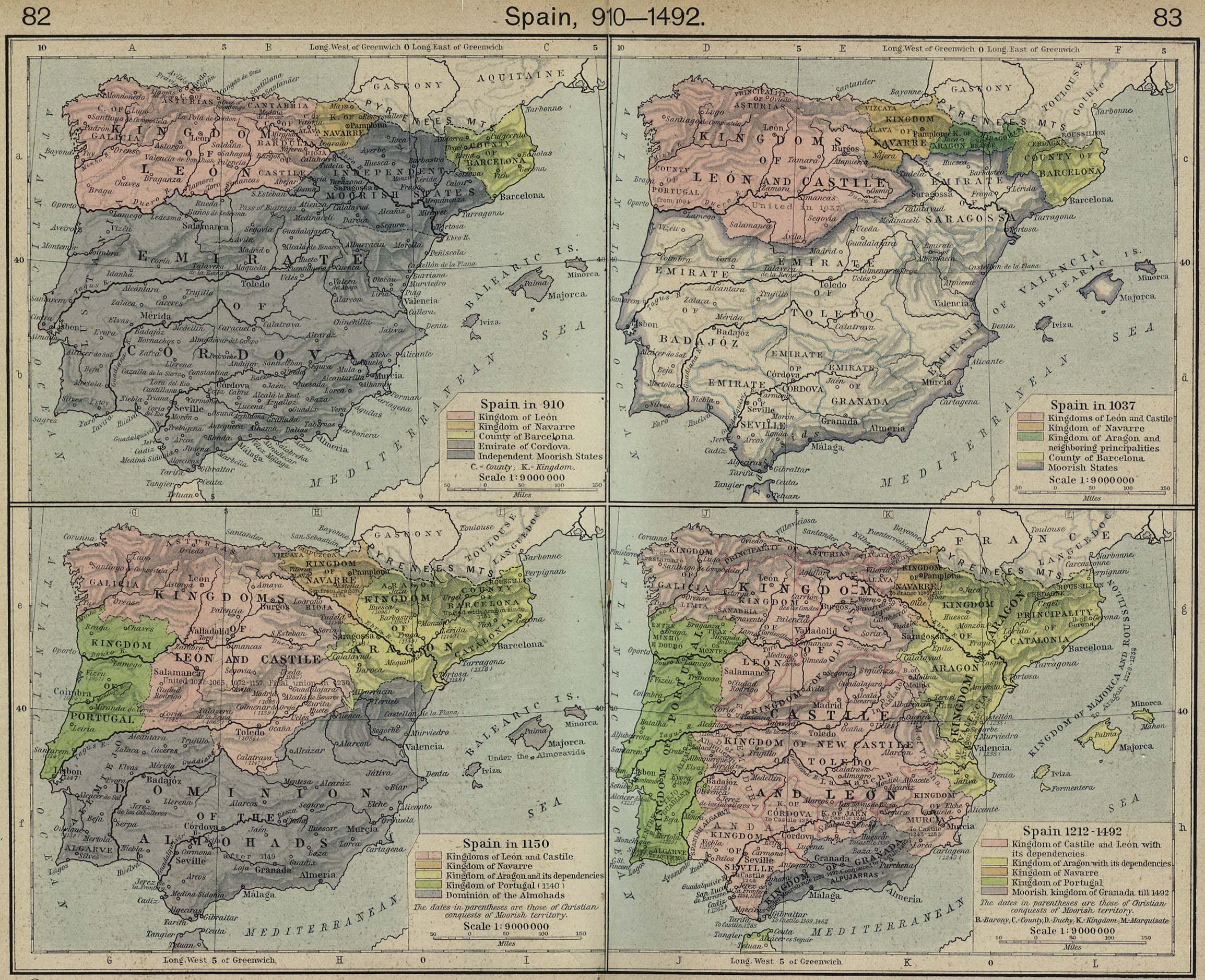
In 1492 the Kingdom of Castile and Leon was the largest Christian kingdom, with Aragon and Portugal somewhat smaller, the Muslim Kingdom of Granada on the coast in the south, the Kingdom of Portugal on the west, and a small Kingdom of Navarre on the east, But the history of these kingdoms remained alive, Thus the Kingdom of Aragon (in addition to its lands outside of the peninsula) included Aragon, Catalonia and Barcelona. Barcelona had a history as a trading state, dominating sea trade in the north western Mediterranean -- a powerhouse of commerce. Aragon's history included a key role in the defense of the frontier. Catalonia had its own language (with many French roots) and cousins over the border living on French territory. Muddling through never succeeded in bringing Aragon and Castile needed to make Spain a single state serving a single nation, That was more true of the failed experiment with unification of Portugal and Spain, The muddling through approach to unification of Spanish and Moors. the Catholics, Protestants and Jews failed even more dramatically,
In the 17th century there was again a change of dynasty -- from Habsburg to Bourbon, from Austrian to French. It was decided on after the War of the Spanish Succession, A french Bourbon ruler was duly installed in Madrid, and many of the innovations introduced in French government structure and function came to Spain. The Austrians stripped Spain of the territory it had held in Italy and the surrounding Mediterranean Islands.
It would be a shame not to mention the magisterial final section that author Elliott provides to the book, titled "Epitaph to an Empire". In the previous chapters he has delved in great detail to who held what position of what issue related to what decision. It was this detail (involving people the non-historian reader would often soon forget) that so annoyed out member (cited above). In the final section of the book Elliot points out how great were the accomplishments of Spain under Isabella and Ferdinand as well as under the early Habsburgs. The world still has the imprint of those accomplishments. Looking at governments and the people who run them today, one wonders if we have really made advances in 400 years.
Apologies for the late posting of this discussion of Elliott's book on Imperial Spain. The holidays, and a lasting problem with allergies were responsible, John Daly