Aug 27, 2014

Evaluation of Books of History


The American Historical Association provides a Statement on Standards of Professional Conduct. It is worth reading some parts of the code. The thrust is that professional historians have an ethical responsibility to provide trustworthy, scholarly contributions to the ongoing dialog about the past. They must leave a record of their work, distinguishing between primary and secondary sources.

The Society of Professional Journalists also has a Code of Ethics. Its primary injunction is to "seek the truth and report it". (Note that the historians are more modest about the possibility of always reporting the truth, although they do believe that "that within certain limits we can indeed know and make sense of past worlds and former times".)

There are also Ethics for Writing Non Fiction. Those ethics requires of the writer of such works that he/she maintain "the highest standard that will ensure the content of your work is true and accurate." "Due diligence" is required of the author.

In the book club we have read works by professional historians, by journalists, and by authors of non-fiction books of history who are neither journalists nor professional historians.

It seems to me that we should consider whether any book provides a trustworthy account of the material it presents -- that the author has seriously sought to discover and report factual material, that when the ideas of others are described, they are described accurately, and when the authors own inferences and conclusions are presented they are identified as such.

We should also demand quality in the writing. Is the book well organized. Is its thesis clear and intelligible. Is the prose clear? Have the author and publisher provided the requisite maps, pictures, charts, timelines, and other materials to help the reader.

If we identify clear ethical misconduct, such as plagiarism or undisclosed financial interests, we should be very cautious in accepting the thesis of the author.


Aug 15, 2014

Where do all the colors come from?

Do you drink Cherry Coke? Did you realize that its color additive E120 is made from cochineal beetles grown on cactus plants?
Victoria Finlay 
Picture a young British woman who has read that the pigment Indian Yellow was made from the urine of cows fed with mango leaves in the town of Monghyr in Bahar. The information comes from a letter written in 1883 by a Mr. Mukharji in India to the Society of Arts in England -- apparently the only reference in English to this purported source of the pigment.  In her search for the mysterious origin of this storied pigment she has been sent to another even smaller village - Mirzapur - to seek out members of the cast of milkmen who were supposed to have made the pigment. Since she does not speak Hindi, she is trying to explain with drawings (worthy of a 6 year old) that she is seeking to learn how their ancestors fed their cows mango leaves and collected the cows' urine a hundred years before. In the heat and dust, a significant part of the town has gathered to watch the interchange, and their incredulity eventually turns to hilarity. Of course they were sure no one in that village had ever done anything so bizarre. (The story convinced one of our members never to travel to a developing country again for fear of being equally ridiculously naive.)
These were two anecdotes that enlivened the discussion Wednesday night of Color: A Natural History of the Palette by Victoria Finlay. As usual we enjoyed the hospitality of the Kensington Row Bookshop, a warm and welcoming place filled with previously read books of all kinds. Fourteen members had a vigorous discussion, based on the very different views of the book held by different members of the group.

The most positive view of the book, shared by several members, was that it was a pleasant account of the travels of a reporter as she traced down information on the sources of many pigments. They saw the book as providing interesting anecdotes of her travels, interesting tidbits of history, local color from all over the world, stories about artists, and sometimes surprising details about the sources of pigments that we take for granted.

A member commented that the book led the reader to think about paintings in a different way, no longer taking for granted the pigments that give color to the subjects. Once one understands the long effort to get pigments to provide vibrant color and the difficulty of preserving those colors, one gains greater appreciation of the craft of the artist. Another member commented that before reading the book she had never realized that there is no pink in a rainbow. Black is probably not what you think it is!

A member mentioned that she had never understood that the development of modern oil paints in the 19th century made it possible to paint outdoors producing pictures with intense colors. That outdoor painting was in part responsible for the revolution approach to painting we call Impressionism, The recognition that the change in technology was necessary to the change in artistic approach was pleasing in itself, but it also added to her enjoyment of impressionist paintings.

One member made the point that this was a welcome change from the heavier stuff that the club had been reading lately, which included a book about death in the Civil War, a book about the northern campaigns of the War of 1812, and a book about the Reformation and Counter-Reformation. Color was an much lighter book and a much  easier and more pleasant read for this member.

Still another member saw the book as making a rather profound philosophical point. Art is regarded differently in different cultures. Thus, Australian Aboriginal painting was many things, but none of them were close to the modern American conception of "art".  In its pre-colonial form, the images made by Australia's indigenous people almost always had mythical meanings relating to their Dreamtime; the images related to a culturally unique way of viewing the world; they influenced the individuals view of himself/herself. (It was noted that some Aboriginal painters today are accomplished artists, painting for a modern, sophisticate art market, drawing on cultural precedents, but using them in a very different way than their ancestors had done.)

Later in the discussion it was suggested that part of the meaning of art in our current American culture relates to the history of development of art. We value a Leonardo, a Michelangelo of a Van Gogh in part for the changes that they exemplified in the way painting and sculpture were done and understood.

On the other hand, several members of the group were quite negative about the book. A couple of members mentioned that they had hoped for a book that would explain things like the development of markets and trade routes for pigments, and some more serious and systematic treatment of how the changes in pigments and other components of paint affected the way artists painted. Victoria Finlay had not written that book. One member compared the experience to expecting to bite into something with a lemon flavor and discovering it was pineapple -- the experience is not pleasant, even though he likes pineapple generally.

Finley briefly describes her understanding of color in terms of the diffraction of light and prisms and the absorption of light by atoms. Her presentation of the physics of color was challenged as partial and flawed. Moreover, she did not describe color perception as the result of the human visual system -- thus, we can perceive the same color differently in different settings, or different colors as the same. It was suggested by her defenders that the author is just a reporter and that it is not a problem if she poorly understood and conveyed what scientists told her about color. The response was, if we doubted her reporting of a subject that we understood reasonably well, how were we to accept the accuracy of her reporting on such things as the meaning of Australian Aboriginal paintings that seem both hard to understand and hard to write about.

Quality in Art

There was quite a vibrant discussion on whether there was really quality in art. One side defended relativism while the other side held out for more general standards of quality in the visual arts. It was argued that art prices vary so much over time that they can not really represent a measure of the quality in what is being sold, and indeed their variability argues against experts having real standards for artistic quality.

One extreme position was that the only thing that mattered in art is whether the individual likes the work -- that there is no fundamental difference in quality between the pictures on the wall of  the member's how and those on the wall of the National Gallery. (A member mentioned having had the pleasure as a teenager of occasionally visiting a home that had works of art by Renoir, Matisse and other Impressionists that sold for more than $80 million in the 1980s; that was a house that he felt really did have paintings of quality comparable to those found in an well endowed art museum.)

In contrast, it was argued that while people have every right to their own taste in art, there are real gradients in talent. Some artists draw more beautiful lines, some have more expertise and skill in the use of color, some have the ability to better compose their works. The member described a session watching an art curator inspect a large number of African paintings selecting those to purchase; the process was quite rapid, and was not focusing on the relation of the works to the culture from to which the artist belonged. Rather, the purchase seemed to be based on metrics of quality such as composition and skill of the artist.

It was agreed that different schools of art at different times had different objectives. Leonardo da Vinci was not trying to do what Picasso was trying to do, and might not have liked Picasso's mature work at all. Yet one member maintained that a metric of quality still applied. Leonardo stood out as great among his contemporaries - as those trying to do the same things that he was trying to do. So too, Picasso stands out as great among the modern artists of the early 20th century.

The thought was expressed that innovation is highly valued in our modern society, and that as a result we judge the quality of modern artist's work in part by the degree to which the artist has pioneered taking art in new directions. Some galleries specialize in seeking out the most talented and innovative artists, and some collectors too seek to buy works of those artists and from those galleries. The artistic works that appreciate in price most rapidly seems to be of that sort.

A Local Issue and The Art Market

One of the members present had coordinated a regional program for art students, based in the Albert Einstein High School Visual Arts Center. This is a nationally recognized facility in which artists provide schooling for artistically gifted students from public and private schools in Montgomery County. He shared some of his experience with us.

Entry into the program of the Visual Arts Center is competitive, and prospective students are not only interviewed but are required to submit portfolios of their work. Only the talented are accepted. Once accepted the student transfers to Einstein full time.  Our member told us that talented and well trained young artists are recruited for higher education, and may find substantial scholarship aid ($100,000 was mentioned) that even exceeds that of star athletes.

By chance, the daughter of another member present had some time ago attended Einstein High School, and had been sure she wanted a career as a artist. At that time the regional arts center had been in another school, and she had been required to transfer. In one of her course, the daughter had learned how to price her work; the naive young artist too often undervalues her work.

Still another member regularly attends the student art shows at one of the Historically Black Colleges and mentioned that while once it had been possible to purchase works by students for $25 or $50, the princes now were in the hundreds. Serious art collectors and dealers have discovered the shows as a place where they can meet young artists of great talent and promise, and see even the higher prices are real bargains for the works of such artists.

So too a member mentioned programs for the mentally ill or intellectually challenged to learn to make art; some of these people turn out to be highly talented artists, and will have successful careers in art. And indeed, the shows of works from such programs also provide a means of purchasing fine works at affordable prices.

Final Comment

It was interesting that so many of the members of the club could discuss art from their personal experience. For example, several had visited the Sistine Chapel and could compare the status of Michelangelo's ceiling before and after its restoration. Several had visited Florence in Italy, and a couple could discuss Leonardo's Last Supper which they had seen during visits to Milan.

This meeting provided one of our most active discussions. Friends can disagree and discuss their differences with courtesy and profit from discussing those differences. Some ideas were changed, some were not. At the least, ideas were clarified.

Here is a post by a member on his own blog stimulated by the discussion.

A member following up the discussion identified this video relating to an advertising ploy by an Ad. Assn.  Fifty-eight pieces of the best art in this country will be on billboards and bus stops around the country this August. Kelly thinks it will lead more people into the museums.

Aug 12, 2014

Books to consider on the Civil Rights Act of 1964


It had also been suggested that we might read a book on the Civil Rights Act of 1964 since this year celebrates the 50th anniversary of that landmark legislation. There are two recent books that might be considered for our October meeting. Both are by journalists with great credentials.

An Idea Whose Time Has Come: Two Presidents, Two Parties, and the Battle for the Civil Rights Act of 1964 by Todd S. Purdum (4.6 stars, 340 pages of text, 2014) The book will not be published in paperback until March of next year, but is available in hardback ($22.23) and used online. Here is a review of the book from The Daily Beast.
A top Washington journalist recounts the dramatic political battle to pass the Civil Rights Act of 1964, the law that created modern America, on the fiftieth anniversary of its passage
It was a turbulent time in America—a time of sit-ins, freedom rides, a March on Washington and a governor standing in the schoolhouse door—when John F. Kennedy sent Congress a bill to bar racial discrimination in employment, education, and public accommodations. Countless civil rights measures had died on Capitol Hill in the past. But this one was different because, as one influential senator put it, it was “an idea whose time has come.”
In a powerful narrative layered with revealing detail, Todd S. Purdum tells the story of the Civil Rights Act of 1964, recreating the legislative maneuvering and the larger-than-life characters who made its passage possible. From the Kennedy brothers to Lyndon Johnson, from Martin Luther King Jr. to Hubert Humphrey and Everett Dirksen, Purdum shows how these all-too-human figures managed, in just over a year, to create a bill that prompted the longest filibuster in the history of the U.S. Senate yet was ultimately adopted with overwhelming bipartisan support. He evokes the high purpose and low dealings that marked the creation of this monumental law, drawing on extensive archival research and dozens of new interviews that bring to life this signal achievement in American history.
Often hailed as the most important law of the past century, the Civil Rights Act stands as a lesson for our own troubled times about what is possible when patience, bipartisanship, and decency rule the day.
The Bill of the Century: The Epic Battle for the Civil Rights Act by Clay Risen (4.6 stars, 320 pages, 2014) The book will not be published in paperback until April of next year, but is available in hardback ($20.20) and used online. Here is a review of the book from the Washington Post.
The Civil Rights Act of 1964 was the single most important piece of legislation passed by Congress in American history. This one law so dramatically altered American society that, looking back, it seems preordained—as Everett Dirksen, the GOP leader in the Senate and a key supporter of the bill, said, “no force is more powerful than an idea whose time has come.” But there was nothing predestined about the victory: a phalanx of powerful senators, pledging to “fight to the death” for segregation, launched the longest filibuster in American history to defeat it.
The bill's passage has often been credited to the political leadership of President Lyndon Johnson, or the moral force of Martin Luther King. Yet as Clay Risen shows, the battle for the Civil Rights Act was a story much bigger than those two men. It was a broad, epic struggle, a sweeping tale of unceasing grassroots activism, ringing speeches, backroom deal-making and finally, hand-to-hand legislative combat. The larger-than-life cast of characters ranges from Senate lions like Mike Mansfield and Strom Thurmond to NAACP lobbyist Charles Mitchell, called “the 101st senator” for his Capitol Hill clout, and industrialist J. Irwin Miller, who helped mobilize a powerful religious coalition for the bill. The "idea whose time had come" would never have arrived without pressure from the streets and shrewd leadership in Congress--all captured in Risen's vivid narrative.
This critical turning point in American history has never been thoroughly explored in a full-length account. Now, New York Times editor and acclaimed author Clay Risen delivers the full story, in all its complexity and drama.

Aug 11, 2014

More Possible Books for October 2014


Following a suggestion in the club meeting last month I have posted several books that we might read that deal with the end of World War I and the Treaty of Versailles that was negotiated at the end of the war. Here are some more, reflecting still more suggestions from members.

A Spy Among Friends: Kim Philby and the Great Betrayal by Ben Macintyre (4.7 stars, 384 pages, 2014) This book is available in Kindle, Hardback ($17.08) and large print paperback ($20.15). Here is the review of the book in the New York Times.
Kim Philby was the greatest spy in history, a brilliant and charming man who rose to head Britain’s counterintelligence against the Soviet Union during the height of the Cold War—while he was secretly working for the enemy. And nobody thought he knew Philby like Nicholas Elliott, Philby’s best friend and fellow officer in MI6. The two men had gone to the same schools, belonged to the same exclusive clubs, grown close through the crucible of wartime intelligence work and long nights of drink and revelry. It was madness for one to think the other might be a communist spy, bent on subverting Western values and the power of the free world.

But Philby was secretly betraying his friend. Every word Elliott breathed to Philby was transmitted back to Moscow—and not just Elliott’s words, for in America, Philby had made another powerful friend: James Jesus Angleton, the crafty, paranoid head of CIA counterintelligence. Angleton's and Elliott’s unwitting disclosures helped Philby sink almost every important Anglo-American spy operation for twenty years, leading countless operatives to their doom. Even as the web of suspicion closed around him, and Philby was driven to greater lies to protect his cover, his two friends never abandoned him—until it was too late. The stunning truth of his betrayal would have devastating consequences on the two men who thought they knew him best, and on the intelligence services he left crippled in his wake.
The Battle of Bretton Woods: John Maynard Keynes, Harry Dexter White, and the Making of a New World Order by Ben Steil (4.4 stars, 370 pages of text, 2014, $15.75) Here is a review of the book in F&D, the magazine of the IMF.
When turmoil strikes world monetary and financial markets, leaders invariably call for 'a new Bretton Woods' to prevent catastrophic economic disorder and defuse political conflict. The name of the remote New Hampshire town where representatives of forty-four nations gathered in July 1944, in the midst of the century's second great war, has become shorthand for enlightened globalization. The actual story surrounding the historic Bretton Woods accords, however, is full of startling drama, intrigue, and rivalry, which are vividly brought to life in Benn Steil's epic account. 
Upending the conventional wisdom that Bretton Woods was the product of an amiable Anglo-American collaboration, Steil shows that it was in reality part of a much more ambitious geopolitical agenda hatched within President Franklin D. Roosevelt's Treasury and aimed at eliminating Britain as an economic and political rival. At the heart of the drama were the antipodal characters of John Maynard Keynes, the renowned and revolutionary British economist, and Harry Dexter White, the dogged, self-made American technocrat. Bringing to bear new and striking archival evidence, Steil offers the most compelling portrait yet of the complex and controversial figure of White--the architect of the dollar's privileged place in the Bretton Woods monetary system, who also, very privately, admired Soviet economic planning and engaged in clandestine communications with Soviet intelligence officials and agents over many years. 
Winner of the 2013 Spear's Book Award in Financial History
Co-Winner of the 2014 Bronze Medal in Economics, Axiom Business Book Awards
From Resistance to Revolution: Colonial Radicals and the Development of American Opposition to Britain, 1765-1776 by Pauline Maier (4 stars, 368 pages, 1992, $12.63) Here is the Kirkus review of the book.
"An intellectual interpretation of the American revolution that raises it to a new height of comprehensiveness and significance. A superbly detailed account of the ideological escalation . . . that brought Americans to revolution." —Gordon S. Wood, New York Times Book Review
In this classic account of the American revolution, Pauline Maier traces the step-by-step process through which the extra-legal institutions of the colonial resistance movement assumed authority from the British. She follows the American Whigs as they moved by stages from the organized resistance of the Stamp Act crisis of 1765 through the non-importation associations of the late 1760s to the collapse of royal government after 1773, the implication of the king in a conspiracy against American liberties, and the consequent Declaration of Independence. Professor Maier's great achievement is to explain how Americans came to contemplate and establish their independence, guided by principle, reason, and experience.
 The Story of a Common Soldier of Army Life in the Civil War, 1861-1865 by Leander Stillwell (4.4 stars, 174 pages, 1920) This book is also available free as a Project Gutenberg eBook. Here are some short reviews from Goodreads.
The Story of a Common Soldier of Army Life in the Civil War, 1861-1865 is presented here in a high quality paperback edition.
 The Great Ulcer War by William S. Hughes M.D. (5 stars but only 3 reviews, 298 pages, 2014) The book seems not to be available new from Amazon, but some copies are available used. Here is the Kirkus review of the book.
In 1983, in Australia, a medical resident, Dr. Barry Marshall, and a hospital pathologist, Dr. Robin Warren, reported in two letters to The Lancet finding a bacterium associated with gastritis or inflammation of the stomach. The publication stimulated little reaction. However, a year later when they reported that the bacterium was also associated with ulcer disease and declared that bacteria caused ulcer disease, it had the effect of an assassination of an archduke. Most prominent clinical investigators in the United States and England argued that hyper secretion of acid was the cause of ulcer disease, and they collaborated with the pharmaceutical companies that made the new drugs that blocked acid secretion to attack the new bacterial theory. The Great Ulcer War tells how the war was fought, the weapons used, and the alliances made, and why the war in spite of overwhelming evidence in favor of the bacterial theory, lasted for ten years. The Great Ulcer War introduces a novel theory, the Pandora Hypothesis, to explain the length of the war. It proposes that the general medical establishment especially in the United States simply did not like the bacterial theories of major chronic diseases. These thought leaders—"the big guys"—facilitated and prolonged the opposition to the bacterial theory of ulcers largely by doing nothing to support the theory until the very end of the war. They were afraid that if a germ theory was accepted for ulcers, a Pandora's Box of germ theories developed within university departments of microbiology for other chronic diseases would be opened and released into the medical world. This revelation would diminish the reputation and profit of the medical establishment and the pharmaceutical industry by threatening their favored explanations of the causes of these diseases: genomic errors and dysfunctional biochemistry and physiology.

Jul 27, 2014

Primarily on the Treaty Ending World War I and the Aftermath.

In the last discussion meeting of the history book club, members expressed interest in reading a book on the Treaty of Versailles that ended World War I and created the conditions that led to World War II. Here are some alternatives:

Prize Winning Histories

The Long Shadow: The Legacies of the Great War in the Twentieth Century by David Reynolds (4.7 stars, 430 pages of text, 2014) The book is not yet out in paperback, hardback $24.25. Here is the review of the book in The Guardian.
One of the most violent conflicts in the history of civilization, World War I has been strangely forgotten in American culture. It has become a ghostly war fought in a haze of memory, often seen merely as a distant preamble to World War II. In The Long Shadow critically acclaimed historian David Reynolds seeks to broaden our vision by assessing the impact of the Great War across the twentieth century. He shows how events in that turbulent century—particularly World War II, the Cold War, and the collapse of Communism—shaped and reshaped attitudes to 1914–18.
By exploring big themes such as democracy and empire, nationalism and capitalism, as well as art and poetry, The Long Shadow is stunningly broad in its historical perspective. Reynolds throws light on the vast expanse of the last century and explains why 1914–18 is a conflict that America is still struggling to comprehend. Forging connections between people, places, and ideas, The Long Shadow ventures across the traditional subcultures of historical scholarship to offer a rich and layered examination not only of politics, diplomacy, and security but also of economics, art, and literature. The result is a magisterial reinterpretation of the place of the Great War in modern history.
Paris 1919: Six Months That Changed the World by Margaret MacMillan (4.3 stars, 494 pages of text, 2003, $11.00) Here is the Washington Post review.
For six months in 1919, after the end of “the war to end all wars,” the Big Three—President Woodrow Wilson, British prime minister David Lloyd George, and French premier Georges Clemenceau—met in Paris to shape a lasting peace. In this landmark work of narrative history, Margaret MacMillan gives a dramatic and intimate view of those fateful days, which saw new political entities—Iraq, Yugoslavia, and Palestine, among them—born out of the ruins of bankrupt empires, and the borders of the modern world redrawn.
Other Histories

A Shattered Peace: Versailles 1919 and the Price We Pay Today by David A. Andelman (4.1 stars, 336 pages, 2007) This is not available in paperback, hardback is $24.50. Here is the short review from Foreign Affairs.
"The failed peace settlement following the Great War of 1914-1918 has been the subject of many fine books. In many respects, David Andelman's A Shattered Peace is the best of these. It is compact and compellingly written. Moreover, it explains more clearly than any other work how the failure of peacemaking in 1919 shaped later history and, indeed, shapes our own era."
--Ernest R. May, Charles Warren Professor of American History, Harvard University 
"The peace settlements that followed World War I have recently come back into focus as one of the dominant factors shaping the modern world. The Balkans, the Middle East, Iraq, Turkey, and parts of Africa all owe their present-day problems, in part, to these negotiations. David Andelman brings it all back to life--the lofty ideals, the ugly compromises, the larger-than-life personalities who came to Paris in 1919. And he links that far-away diplomatic dance to present-day problems to illuminate our troubled times. A tremendous addition to this vitally important subject."
--Ambassador Richard Holbrooke

To End All Wars: Woodrow Wilson and the Quest for a New World Order by Thomas J. Knock (4.3 stars, 400 pages, 1995, $32.53) Here is the Kirkus review.
In his widely acclaimed To End All Wars, Thomas Knock provides an intriguing, often provocative narrative of Woodrow Wilson's epic quest for a new world order. The account follows Wilson's thought and diplomacy from his policy toward revolutionary Mexico, through his dramatic call for "Peace without Victory" in World War I, to the Senate's rejection of the League of Nations. Throughout Knock explores the place of internationalism in American politics, sweeping away the old view that isolationism was the cause of Wilson's failure and revealing the role of competing visions of internationalism--conservative and progressive.

A Peace to End All Peace: The Fall of the Ottoman Empire and the Creation of the Modern Middle East by David Fromkin (4.5 stars, 568 pages of text, 2001) This seems to be out of print, but available online used. Here is the New York Times Review.
The critically acclaimed New York Times bestselling account of how the modern Middle East came into being after World War I, and why it is in upheaval today
In our time the Middle East has proven a battleground of rival religions, ideologies, nationalisms, and dynasties. All of these conflicts, including the hostilities between Arabs and Israelis that have flared yet again, come down, in a sense, to the extent to which the Middle East will continue to live with its political inheritance: the arrangements, unities, and divisions imposed upon the region by the Allies after the First World War.
In A Peace to End All Peace, David Fromkin reveals how and why the Allies came to remake the geography and politics of the Middle East, drawing lines on an empty map that eventually became the new countries of Iraq, Israel, Jordan, and Lebanon. Focusing on the formative years of 1914 to 1922, when all-even an alliance between Arab nationalism and Zionism-seemed possible he raises questions about what might have been done differently, and answers questions about why things were done as they were. The current battle for a Palestinian homeland has its roots in these events of 85 years ago.
Reparation in World Politics: France and European Economic Diplomacy, 1916-1923 by Marc Trachtenberg (only one rating, 423 pages, 1980, apparently out of print but available online used) Read a very short review in Foreign Affairs.

Histories for Which I Did Not Find Published Reviews

The Illusion of Peace: International Relations in Europe, 1918-1933 by Sally Marks; second edition (4.2 stars with relatively few ratings, 272 pages, 2003, $33.65)
Sally Marks' compelling analysis of European diplomacy between World War I and Hitler's advent, explores the reasons why a lasting peace failed to occur in the interwar era. Building on the theories of the first edition, Marks argues that the Allied failure to bring defeat home to the German people, and the consequences of this oversight, were partly to blame, and reassesses Europe's leaders and the policies of the powers. Thoroughly revised and updated in the light of recent scholarly and documentary research, the second edition of this highly successful text also includes new material, maps, and an extended bibliography.
The Versailles Settlement: Peacemaking After the First World War, 1919-1923 by Alan Sharp (3 stars with relatively few ratings, 288 pages, 2008, $42.00) I could not find a published review.
This text has established itself as one of the most highly regarded studies on the subject. Revised and expanded, this second edition incorporates the latest research and includes more discussion of the roles of the League of Nations after the conference, and of the post-war conflicts between Poland and the USSR, and between the USSR and Turkey.


A more general book that includes a number of relevant chapters to diplomacy at the end of World War I.

Diplomacy by Henry Kissinger (4.5 stars, 836 pages of text, 1995, $14.55) Here is the New York Times review, which Mr. Kissinger did not like.
A brilliant, sweeping history of diplomacy that includes personal stories from the noted former Secretary of State, including his stunning reopening of relations with China.
The seminal work on foreign policy and the art of diplomacy.
Moving from a sweeping overview of history to blow-by-blow accounts of his negotiations with world leaders, Henry Kissinger describes how the art of diplomacy has created the world in which we live, and how America’s approach to foreign affairs has always differed vastly from that of other nations.
Brilliant, controversial, and profoundly incisive, Diplomacy stands as the culmination of a lifetime of diplomatic service and scholarship. It is vital reading for anyone concerned with the forces that have shaped our world today and will impact upon it tomorrow.
 Note: Prices given are taken from Amazon.com and are for comparison only.

Jul 12, 2014

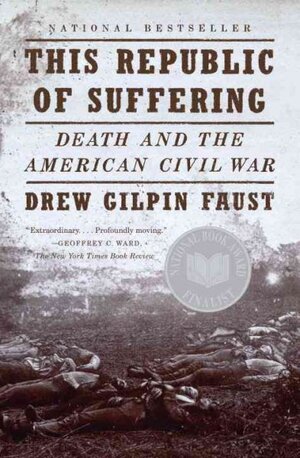
Discussion of "This Republic of Suffering"


Eleven of us showed up Wednesday night, a relatively small showing, to discuss This Republic of Suffering: Death and the American Civil War by Drew Gilpin Faust. This book won both the Bancroft Prize and the American History Book Prize in 2008. It deals with issues related to deaths of soldiers during the Civil War, especially what happened after their deaths. We received the warm hospitality from Elisenda Sola-Sole and the Kensington Row Bookshop to which we have become accustomed.

The Civil War was the first "industrial scale' war. Millions of men served in uniform. Weapons were more deadly as compared with those used in previous wars, and mass produced. Troops and supplies could be moved long distances via railroad, and communications could be transmitted by telegraph. Author Faust cites there being and estimated 620,000 deaths of soldiers in the war (the Washington Post on Wednesday stated that historians now put the number at 740,000); most of those who died did so of disease rather than in battle. Faust indicates that the people of the United States embarked on a new relationship with death as a result of this industrial slaughter.

We had an active discussion of the book, occasionally digressing from the main subject (as we so often do). Thus we talked about music related to war deaths, and the relative success of different generals, Civil War poetry, and Ambrose Bierce's Devil's Dictionary.

We noted that the Civil War was fought largely by volunteer armies; there were relatively few professional soldiers. The impact of battle and the soldiers life would have been different for a farm boy from Iowa or North Carolina than for a professional soldier, and the way a family might experience of the death of a volunteer would be different than the way a family might experience the death of a professional soldier -- different and more difficult.

We also note that in the Confederate army, the enlisted soldiers would have been of a lower class than the officers. (Less than one-third of Confederate whites owned any slaves, and only a small portion of that  third owned large plantations with many slaves.) Plantation owners who chose to serve in the Confederate army would have taken their arms, horses and slaves with them and become officers. Still we thought that southern troops generally supported their cultural institutions. Indeed, they would have supported the institution of slavery even not owning slaves, if only because the slaves and not the poor whites were at the bottom of the social structure.

We noted that mortality was much higher in the 19th century than it is today. While two percent of the population died as soldiers during the war, or an average of one-half of one percent per year, the prewar mortality was about 1.4 percent per year. People were more used to death than we are today, although the deaths of men of military age would even then have been relatively rare in normal years. During the war women would continue to die (often giving birth) as would children and old people. Thus the soldiers might have represented something over a quarter of the total deaths each year.

It was the Victorian age. Women were expected to grieve differently than men. Indeed, women were expected to wear deep mourning black for a year after the death of a husband, and a somber grey for another year after that; men were expected to be more stoic and to return to their work and normal duties relatively quickly.
The Good Death

We discussed author Faust's use of quotations from letters to their homes from soldiers, especially emphasizing the preparation for a "good death". Faust indicates that one of the aspects believed to make for a good death at the time was to die at home, surrounded by family and friends. That of course did not happen for the men who died in battle, in the field hospitals of their wounds, in camps of disease, or on the march. Faust describes efforts to provide surrogates to comfort the dying from comrades in arms, doctors and nurses; she also describes the efforts to write to relatives providing details of the death.

Faust seems to take these letters at face value. It was suggested that letters from young people home to their families may have systematic distortions of the writers actual feelings and perceptions of their surroundings. A member suggested that when he was a young man living far from home, he certainly crafted letters home with some care; another suggested that daughters don't tell their families everything. Similarly, letters from military superiors and comrades reporting a death to the deceased's family are likely to be empathetic to the distress that that family would expect to be feeling.

One member was rather eloquent describing the anguish of a mother whose son had died, wanting to know when and how it had happened, whether he had suffered, and where he was buried. For a great many of the Civil War dead, their burial place was not known to their families until after the war or indeed ever. For some, believing in the resurrection of the body, the interment of the body of a loved one had great importance.

It was noted that many Irish immigrants would have been recruited for the army as they got off the boat from Ireland. There was a custom at the time (and indeed that lasted much later) to hold an "American wake" for a young Irish man or woman departing for America in recognition that he/she would probably never see his/her family again, that they would not have had the benefit of his/her presence at the death of Irish family members, nor of those left behind at the death of the American relative. These Irish immigrant soldiers did not share the expectation of a death at home surrounded by loved ones that author Faust attributes to the citizen soldiers.

The majority of the soldiers were members of Protestant denominations and Faust suggests that there were a number of factors contributing to a "good death": the person should be conscious of his fate, willing to accept it, shown signs of belief in God and in his own salvation, and leave messages for those who would in normal times have been at his side. Faust suggests that there was a convergence in these beliefs among all denominations, including Catholics and Jews.

One member expressed doubts. He suggested that Catholic soldiers would have believed a good death involved confession of his sins, absolution by a priest, the last sacrament administered by a priest, and burial in holy ground. We mentioned the "conditional absolution" given by Father Corby at Gettysburg to the Irish Brigade (the Catholic priest who later became head of Notre Dame University, who served the mostly Catholic Irish-American soldiers), but the member suggested that most of the Catholic soldiers who died on the battlefield would not have felt that their religious needs at death had been met.

A member mentioned that he understood that it was not uncommon for non-Catholics to ask for a priest to hear a general confession for absolution of sins, and that he had conversations with a retired priest who had himself heard such confessions.

A criticism of the book was that it probably did not do justice to the diversity of responses to death in the differing subcultures from which the soldiers and their families were drawn. Families living in the teaming slums of New York and Philadelphia may not have reacted in the same way as farm families in the north; southerners were deserting the Confederate army in large numbers toward the end of the war, in part because their families were in desperate need for their help at home; the death of such a soldier might have been catastrophic for his wife and children. Indians had been involved and it was noted that the largest mass hanging in American history was of Indians during the Civil War; how would Indian families respond to the death of an Indian soldier?

One of our members who could not attend the meeting had earlier emailed using our club list-serve that he felt the book did not do justice to the situation of these black troops, so hated by the southerners.  There were some 180,000 blacks who enlisted on the Union side starting in 1862.
  • We assumed that most of these were free before the war rather than freed slaves. These soldiers probably tended to fight for more personal and deeply felt reasons than did white soldiers. Would their families have reacted differently than white families to the death of a soldier family member?
  • As massacres at Fort Pillow and at Poison Springs, Arkansas indicated, black soldiers might well be executed rather than treated as prisoners after being captured during battle. They clearly did not have a "good death". How would family members of have responded to the death of a soldier shot after being captured?
  • Some of the black soldiers would have been escaped slaves, whose families remained in slavery or perhaps were in the "Contraband Camps" (camps set up for emancipated slaves who had sought Union protection); how would those families learn of the deaths of the beloved soldiers? How would they mourn them?
(Surprisingly perhaps, we did not discuss the book's chapter titled "Killing", perhaps because none of us had had experience of serving as a soldier in battle and thus had little basis to judge why soldiers killed in battle and how they felt about doing so. I assume that neither had author Drew Gilpin Faust.)

One member mentioned the extensive notes provided by author Faust, a professional historian. That led to a discussion of sources. Some members found the references to letters to be useful and informative. Another quoted that "the plural of anecdote is not data".  Statistical analysis of the mail from three million soldiers written over four years would be a huge effort, and apparently was not undertaken for this book. It was also noted that young people away from home do not always write the truth in letters to the home folk, and it is perhaps dangerous to take the content of these letters as factual. So too, writing about the death of someone to their family, one tends to be kind to the deceased rather than brutally honest.

The book is fundamentally about an aspect of American culture and its change during the Civil War, and notes to other authors' works that have considered these changes are quite appropriate. A scholarly analysis of cultural change should take into account what other scholars have written on the subject, and appropriate notes to sources would help many readers.

Union soldiers wounded during the July 29, 1862, Battle of Savage’s Station in Virginia lie outside a field hospital near the battlefield.

Failures During the War

From today's vantage point, we percieve that the death rate was too high during the war. Far too many people died of disease, in part because of poor hygiene in the military camps. It was noted in our discussion that the situation was so bad that soldiers camped around Washington, Richmond and other cities polluted water supplies for the civilian population causing civilian disease outbreaks. A member mentioned that Willie Lincoln in Washington and Willie Sherman (the son of William Tecumseh Sherman) in Vicksburg both died of typhoid during such outbreaks.

Wounded soldiers might lie on a field of battle for a day or more before receiving medical attention for lack of ambulances and for lack of periods of ceased fire to enable their recovery. A wounded soldier who reached a field hospital they might wait days until an overworked surgeon could provide service; often the only available treatment was amputation; sometimes the doctor would have amputated many patients limbs without cleaning his instruments nor his hands.

While soldiers sometimes tied identification notes to their clothing, often the bodies of dead soldiers could not be identified. Indeed, when a defeated army left a battlefield often its dead were dumped in mass graves or simply left to rot in the open.

Rosters of soldiers killed and wounded were required, but apparently often neglected. Officers seeking to recover from battle and reorganize their troops, perhaps retreating, apparently had little time nor interest in accurate record keeping. Moreover, late in the war it may have been difficult to find out if specific soldiers had been killed, had been captured, had been wounded and taken to receive medical treatment (and perhaps sent home disabled or died) or simply deserted.

A letter might be written to a dead soldier's family by the officer under whom the soldier had served, or by a fellow soldier, or by someone in the hospital in which he had died, but their was no formal system for the government to notify next of kin. There was even less possibility of notification of family for someone missing in action.

While the bodies of a few notables were shipped home, the best most soldiers could hope for was a rapid burial in a makeshift coffin and poorly marked grave. Southerners were especially viscous toward Union soldiers, and most so toward black Union soldiers. One Union soldier's remains were found with a pitchfork stabbed through its back. Many soldiers were buried in mass graves. Other bodies were simply left where they had fallen.

In the south, it was often the former slaves who created cemeteries for the Union dead and tended them. While the government in Washington treated the Confederate dead as traitors, denying them military honors comparable to those of its Union soldiers for decades after the war, the Confederate anger was still more extreme.

Institutional Development

An important aspect of the book is its discussion of institutional change. There was a medical corps at the beginning of the war, and field hospitals were established at battlefields (albeit inadequate to the needs), but there was no ambulance service. The book describes how the father of a dead soldier made it his mission in life to convince the army to establish its ambulance service; he was successful in that endeavor.

At the outbreak of the war there was no formal governmental systems for identifying the dead, notifying their families, nor providing "decent" graves. There were no national graveyards. Death registries, notifications, and national cemeteries were all institutionalized by the government as a result of the Civil War.

The book also describes Americans reacting to the war by creating non-governmental organizations such as the Sanitary Commission and the Christian Commission in the north and women's groups who organized cemeteries for the dead soldiers in the South. Clara Barton in 1865 created an office for correspondence with the families of missing men, helping to fulfill the need for information about loved ones who did not return from the war. Clara Barton at the beginning of the war collected bandages, food and clothing from Ladies' Aid societies for the troops, and eventually worked to clean field hospitals, apply dressings to wounds, and serve food to wounded soldiers, having gotten military permission to fill an unmet need.

The private sector also played its role commercializing aspects of death, for example selling coffins (including sealed ones for shipping bodies home). Embalming for such shipments was sufficiently common that it fostered embalming becoming common among the civilian population. Mathew Brady's company photographed battlefields and exhibited the images. Reporters telegraphed news from the front, and newspapers printed lists of the local dead.

Final Comments

One member saw this book as opening a number of new fields for historical research. Did different subcultures in America respond to the wholesale deaths of soldiers in the Civil War differently, and if so how and why? Indeed, the book barely begins the academic analysis of the ways in which the Civil War experience changed American culture's treatment of death.

We found it hard to empathize with the feelings of our ancestors as described in this book. Some of the mourning customs seem strange and artificial. So too do some of their religious beliefs. We could not understand their apparent callousness with regard to the bodies of dead soldiers nor fully relate to the ways that grief was expressed by their families.

The discussion was initiated calling upon one member who we knew in advance liked the book. Her opinion was shared by some other members who were present. Several members had not read it, perhaps due to the summer doldrums or the dark topic. At least one member found many problems with the book. Thus there did not seem to be consensus.

Vicksburg National Military Cemetery

Jun 30, 2014

Possible Books for September, 2014

One of the possibilities that came out of the last book club meeting was to read a book on World War I in October or November, given that so many good books on the beginning of the war are available, but many of them are long. Please take a look again at the discussion of those books.

Someone suggested a biography of Catherine the Great. Given her role in the creation of the "modern" Russian state, this seems an interesting idea. 

Catherine the Great: Portrait of a Woman by Robert K. Massie (4.4 stars, this edition 2012, 574 pages) Here is a review.
The Pulitzer Prize–winning author of Peter the Great, Nicholas and Alexandra, and The Romanovs returns with another masterpiece of narrative biography, the extraordinary story of an obscure German princess who became one of the most remarkable, powerful, and captivating women in history. Born into a minor noble family, Catherine transformed herself into empress of Russia by sheer determination. For thirty-four years, the government, foreign policy, cultural development, and welfare of the Russian people were in her hands. She dealt with domestic rebellion, foreign wars, and the tidal wave of political change and violence churned up by the French Revolution. Catherine’s family, friends, ministers, generals, lovers, and enemies—all are here, vividly brought to life. History offers few stories richer than that of Catherine the Great. In this book, an eternally fascinating woman is returned to life.
Someone suggested this book:

This original, deeply researched history shows the transcontinentals to be pivotal actors in the making of modern America. But the triumphal myths of the golden spike, robber barons larger than life, and an innovative capitalism all die here. Instead we have a new vision of the Gilded Age, often darkly funny, that shows history to be rooted in failure as well as success. 8 pages of illustrations
The Civil Rights Act of 1964 is being celebrated this year, and it was suggested that we might read a relevant book.

An Idea Whose Time Has Come: Two Presidents, Two Parties, and the Battle for the Civil Rights Act of 1964 by Todd S. Purdum (4.5 stars, 2014, 340 pages of text). The book is available in hardback and kindle, but the paperback will not be published until 2015. Here is a review.
A top Washington journalist recounts the dramatic political battle to pass the Civil Rights Act of 1964, the law that created modern America, on the fiftieth anniversary of its passage
It was a turbulent time in America—a time of sit-ins, freedom rides, a March on Washington and a governor standing in the schoolhouse door—when John F. Kennedy sent Congress a bill to bar racial discrimination in employment, education, and public accommodations. Countless civil rights measures had died on Capitol Hill in the past. But this one was different because, as one influential senator put it, it was “an idea whose time has come.”
In a powerful narrative layered with revealing detail, Todd S. Purdum tells the story of the Civil Rights Act of 1964, recreating the legislative maneuvering and the larger-than-life characters who made its passage possible. From the Kennedy brothers to Lyndon Johnson, from Martin Luther King Jr. to Hubert Humphrey and Everett Dirksen, Purdum shows how these all-too-human figures managed, in just over a year, to create a bill that prompted the longest filibuster in the history of the U.S. Senate yet was ultimately adopted with overwhelming bipartisan support. He evokes the high purpose and low dealings that marked the creation of this monumental law, drawing on extensive archival research and dozens of new interviews that bring to life this signal achievement in American history.
Often hailed as the most important law of the past century, the Civil Rights Act stands as a lesson for our own troubled times about what is possible when patience, bipartisanship, and decency rule the day.
It was suggested that we might read a biography of Metternich. There is a famous one, out of print but available used at affordable prices.

A World Restored: Metternich, Castlereagh and the Problems of Peace, 1812-1822 by Henry A. Kissinger (4.1 stars, 1973, 354 pages) Here is the Kirkus review.
The Napoleonic Wars were followed by an almost unprecedented century of political stability. A World Restored analyses the alliances formed and treaties signed by the world's leaders during the years 1812 to 1822, focussing on the personalities of the two main negotiators: Viscount Castlereagh, the British foreign secretary, and Prince von Metternich, his Austrian counterpart. Henry Kissinger explains how the turbulent relationship between these two men, the differing concerns of their respective countries and the changing nature of diplomacy all influenced the final shape of the peace. Originally published in 1957.
In 2009 we read Rites of Peace: The Fall of Napoleon and the Congress of Vienna by Adam Zamoyski which covered some of the same material.

It occurs to me that we have not read anything about U.S. foreign policy per se. A relatively new book seems interesting:

The Blood Telegram by Gary J. Bass (4.5 stars, 2014, 346 pages of text) Here is a review.
This magnificent history provides the first full account of Richard Nixon and Henry Kissinger’s secret support for Pakistan in 1971 as it committed shocking atrocities in Bangladesh—which led to war between India and Pakistan, shaped the fate of Asia, and left major strategic consequences for the world today.
Drawing on previously unheard White House tapes, recently declassified documents, and his own extensive investigative reporting, Gary Bass uncovers an astonishing unknown story of superpower brinkmanship, war, scandal, and conscience. Revelatory, authoritative, and compulsively readable, The Blood Telegram is a thrilling chronicle of a pivotal chapter in American foreign policy.
Finalist for the Pulitzer Prize in General Nonfiction; Winner of the Lionel Gelber Prize for Best Foreign Affairs Book; One of the Best Books of the Year at * The Economist * Financial Times * The New Republic * The Washington Post * Kirkus Reviews * A New York Times Notable Book
This also seems an interesting book, dealing with a country we have not read about but which has some importance in the world.

Indonesia, Etc.: Exploring the Improbable Nation by Elizabeth Pisani (unrated, 2013, 380 pages of text) Here is a review.
Indonesia "is the world’s fourth most populous nation and third most populous democracy. With 210 million citizens who identify as Muslim, Indonesia is also the country with the largest number of Muslims. The Indonesian capital, Jakarta, tweets more than any other city on earth, and around 64 million Indonesians (more than the population of the United Kingdom) use Facebook. It is among the world’s largest suppliers of thermal coal, palm oil, copper, tin, nickel, gold, rubber, coconuts, rice, and coffee." Los Angeles Review of Books
Previously I thought we might want to read about history related to current hot spots, especially Poland (for its relevance to the Ukrainian crisis) or Syria. I identified several relevant books. The best of these seem to be:

Poland: A History by Adam Zamoyski  (4.3 stars, 2012, 426 pages) Here is a review.
As Zamoyski set out to update The Polish Way, his bestselling first history of Poland, he realized the task required not so much re-writing as re-thinking the known facts well as the assumptions of the past. The events of the last twenty years and the growth of the independent Polish state allowed him to look at Poland's past with a fresh eye. Tracing Poland's complex development from the Middle Ages to present day, Zamoyski examines the country's political, economic, and military struggles, as well as its culture, art, and richly varied society through the ages, bringing the major events and characters in Poland's history to life.
Asad: The Struggle for the Middle East by Patrick Seale (3.9 stars, 1990, 495 pages of text) A review is here.
“This is a book in the finest tradition of investigative scholarship. The research is awesome. . . . Seale’s great strength is his ability to explain the confusing kaleidoscopic nature of Middle Eastern diplomacy. He understands the game being played and also knows the players. . . . [An] impressive book.”—Los Angeles Times Book Review
And a late addition, by one of my favorite authors:

Beyond the Hundredth Meridian: John Wesley Powell and the Second Opening of the West by Wallace Stegner (4.5 stars, 1953 reprinted edition 1992, 367 pages of text) Here is the Kirkus review.
In this book Wallace Stegner recounts the sucesses and frustrations of John Wesley Powell, the distinguished ethnologist and geologist who explored the Colorado River, the Grand Canyon, and the homeland of Indian tribes of the American Southwest. A prophet without honor who had a profound understanding of the American West, Powell warned long ago of the dangers economic exploitation would pose to the West and spent a good deal of his life overcoming Washington politics in getting his message across. Only now, we may recognize just how accurate a prophet he was.
"This book goes far beyond biography, into the nature and soul of the American West. It is Stegner at his best, assaying an entire era of our history, packing his pages with insights as shrewd as his prose." —Ivan Doig 
"Stegner’s book now ranks as one of the most influential books ever written about the West, and more than any other work its publication explains Powell’s resurrection to sainthood after World War Two." -- Donald Worster